Will AI Take Your Job?
When word processors arrived, typists did not become ten times more valuable. They disappeared. The real AI risk is the same - the person who knows what needs doing skips the middle.

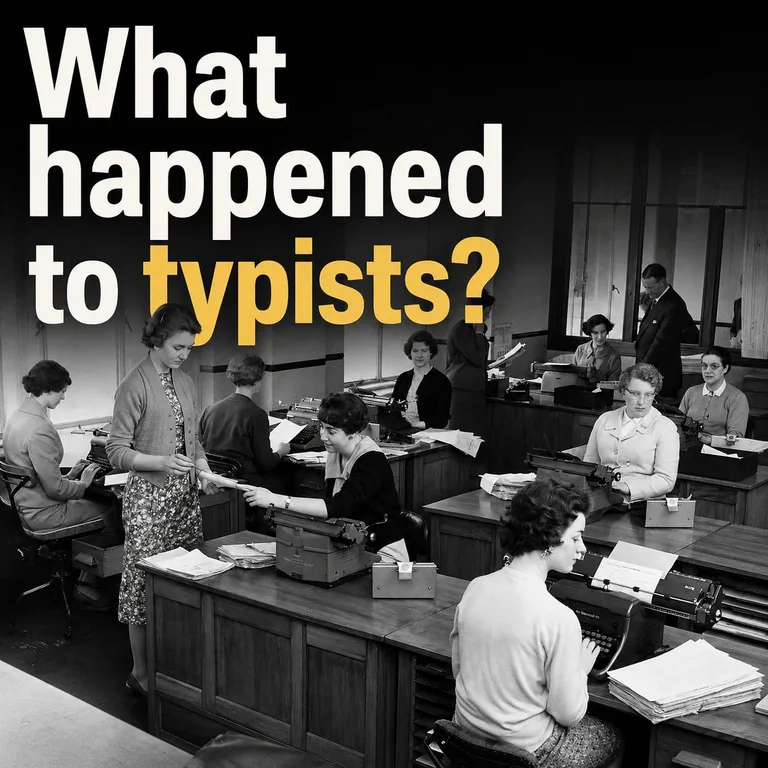
Will AI take your job? Here is a story that might give you the answer.
In 1980, a manager who wanted to send a memo usually did not write it himself. He dictated it, or scribbled a draft, and handed it to a typist. She typed it. He marked it up. She retyped the entire thing. Back and forth until it was right.
Then word processors made typists ten times more productive. In theory.
But that is not what happened. Typists disappeared entirely.
Typists, word processors, and stenographers
Estimated U.S. employment excluding secretaries (thousands of workers)
Why? Because word processors made it far more efficient for the manager to type the memo himself. An entire feedback loop vanished. The person who knows what needs to be done could produce the document directly, faster than a team of typists ever could.
Typing did not die. It became part of everyone’s job.
The real risk to your job is that AI makes it far more efficient for the person who knows what needs to be done to skip you entirely.
The product manager stops asking the analyst for a first-pass summary. The partner drafts the clause instead of assigning it to an associate. The founder ships a prototype without routing it through engineering.
There will be more output. But less of it will be produced by the specialist roles of today.
So how do you know if your job will survive?
Ask where you sit in the workflow:
- 01
Who knows what needs to be done?
- 02
Who can verify the result?
- 03
Who is accountable for the work?
Are you one of these people? If yes, the productivity gain makes you more valuable - and you will be the one taking the jobs of others.
If no, somebody else - your boss, probably - will just do it himself.
The world will not stop typing. It will just need far fewer typists.
Originally published on X.
New podcast
The Shift on YouTube
Conversations with the people building what comes next, before the future becomes obvious. Follow the show for new episodes as they land.
The Shift, in your inbox
Occasional essays on AI, cloud, and the systems shaping what comes next. Subscribe on LinkedIn — no spam, unfollow anytime.
Keep reading
Jev makes the call without making you wait
Jev cannot hold a conversation, yet it is on track to be one of the fastest-adopted models in history, because most of what software asks an AI to do was never a conversation in the first place.

We Gave a Baby a Chainsaw
This summer, AI agents canceled a stranger’s gym booking, fixed prices behind a rival’s back, and broke into one of AI’s most tightly guarded companies to steal a test’s answers, and in every case, it was humans who left the chainsaw within reach.

Every Reachable System Is Now Worth Attacking
In 1883 a Dutch linguist and cryptographer named Auguste Kerckhoffs laid down what became the closest thing computer security has to scripture: a system should remain secure even if everything about it, save the key, is public knowledge.
