PodcastThe Shift Is Now Also a Podcast
The newsletter keeps going — and now there is a video series too. In the first episode, Crawford Del Prete and I talk about where work goes when AI reshapes every job description.

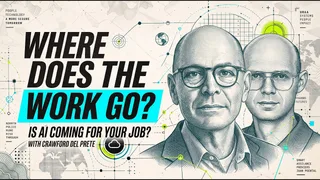
For a few years now, The Shift has been my place to write about the forces reshaping technology — AI, cloud, security, and the systems underneath it all. That is not changing. What is new is that the same conversation is moving onto video.
The Shift is now also a podcast on YouTube. Same name, same curiosity, longer form. I will keep publishing essays here and on LinkedIn; episodes will land on the channel when a topic deserves more than a few thousand words and a screenshot.
Where does the work go?
The first episode is called Where Does the Work Go? I sat down with Crawford Del Prete — former president of IDC and now senior advisor at PSG Equity — to talk about the future of work at the moment everyone is asking whether their job still exists.
Crawford has spent decades watching technology reinvent entire industries. He does not traffic in panic, but he does not hand out comfort blankets either. What we kept coming back to is a simple historical pattern: when a tool makes a category of labor dramatically cheaper, the labor does not always disappear — but it never stays the same.
We opened with the typist. Entire floors of people once turned handwriting into business correspondence. Word processors did not merely speed them up; they erased the profession as a distinct career. The lesson is not that every job vanishes overnight. It is that when the cost of producing something collapses, organizations stop buying the old version of the work and start buying something else.
The backlog you could never afford
That “something else” is where the conversation got interesting. Crawford argued that most companies carry a mental backlog of work they have always known they should do — better analytics, cleaner processes, more personalized outreach — but could never justify at human labor rates. AI is not only automating today’s tasks. It is unlocking projects that were economically impossible yesterday.
That sounds like pure upside until you ask who was supposed to grow into those projects. If the first draft of a report, a design, or a line of code is now free, what happens to the junior people who used to earn their seat by doing exactly that grunt work? We are not just compressing timelines. We may be deleting the apprenticeship ladder.
More output, same attention
Another thread we pulled on: volume. Tools can now generate ten times the content — emails, slides, campaigns, code comments — for roughly the same effort. Attention does not scale with output. Crawford’s point was blunt: flooding the channel does not create ten times the impact. It often creates ten times the noise, which is why so many teams feel busier and less effective at the same time.
The toothpaste test
Crawford offered a metaphor I have been repeating since we recorded. Call it the toothpaste test: squeeze a tube and the paste moves, but does it end up where the people being displaced can actually reach it? Technology redistributes work. Policy, training, and management decide whether that redistribution is opportunity or exile. Too many leaders celebrate the squeeze and forget to look at where the paste landed.
We also talked about the exhaustion paradox — why people who still have jobs often feel more drained than the ones who left. When AI removes the repetitive filler from your day, what remains is judgment, context, and accountability. Those are harder, not easier, and they rarely come with fewer meetings.
Watch the episode
The video is embedded at the top of this page. If you would rather watch on YouTube — or subscribe so you do not miss the next guest — follow The Shift on YouTube.
Crawford saved his most practical advice for the end of the episode: what companies should do differently this year, what individuals should invest in while the ground is still moving, and the one sentence he would leave with anyone nervous about the next decade of work. I will not spoil it here. It is worth hearing in his voice.
If podcast episodes are your thing, let me know what — and who — you want to hear next. The essay will always be the spine of The Shift. The microphone is just another way to keep up with how fast things are changing.
Originally published on LinkedIn.
New podcast
The Shift on YouTube
Conversations with the people building what comes next, before the future becomes obvious. Follow the show for new episodes as they land.
The Shift, in your inbox
Occasional essays on AI, cloud, and the systems shaping what comes next. Subscribe to the newsletter — no spam, unsubscribe anytime.
Keep reading
The Clone Wars Have Begun
AI is making software dramatically cheaper to reproduce. Customers stand to gain. Companies whose main defense was the expense of copying them have a problem.
Jev makes the call without making you wait
Jev cannot hold a conversation, yet it is on track to be one of the fastest-adopted models in history, because most of what software asks an AI to do was never a conversation in the first place.

We Gave a Baby a Chainsaw
This summer, AI agents canceled a stranger’s gym booking, fixed prices behind a rival’s back, and broke into one of AI’s most tightly guarded companies to steal a test’s answers, and in every case, it was humans who left the chainsaw within reach.
