When You Control the Model, You Control Information
In an iconic episode of Seinfeld, the scheming mailman Newman declares with a gleeful smirk, “When you control the mail, you control information.” His…


In an iconic episode of Seinfeld, the scheming mailman Newman declares with a gleeful smirk, “When you control the mail, you control information.” His assertion, dripping with comedic menace, captures a profound truth: controlling communication shapes what people know. In the age of AI, this principle resonates anew. Those who control AI models - the generators and processors of information - effectively control knowledge itself.
Yet this control is not neutral. Model alignment - the process of tuning AI to reflect specific values - is a human intervention, bending raw data to fit the worldview of its creators. The stakes are immense. As a handful of dominant models increasingly shape content, science, education, and beyond, society teeters on the edge of a precipice.
Model alignment is often presented as a technical necessity to ensure AI behaves safely and usefully. At its heart, though, it is an act of curation. Raw training data - vast, chaotic, and reflective of humanity’s unfiltered output - is not simply fed into a model as is. It is shaped, filtered, and adjusted to align with the priorities and values of those building it. This isn’t a conspiracy. Without alignment, AI might mirror the worst of humanity, as seen in Microsoft’s Tay, an early 2016 chatbot that, within hours of launch, began spewing racist remarks after learning from unfiltered Twitter interactions. Statistics alone don’t dictate what an AI deems “true” or “acceptable”; human hands turn the dials.
A model trained for politeness might shield its provider from complaints but end up sugar-coating reality or avoiding important, sensitive topics altogether. One optimized for profit might lean into sensationalism to drive engagement. And one shaped by corporate legal teams - ever wary of risk and litigation - may default to the safest possible output, sidestepping anything that could offend, provoke, or be construed as liability.
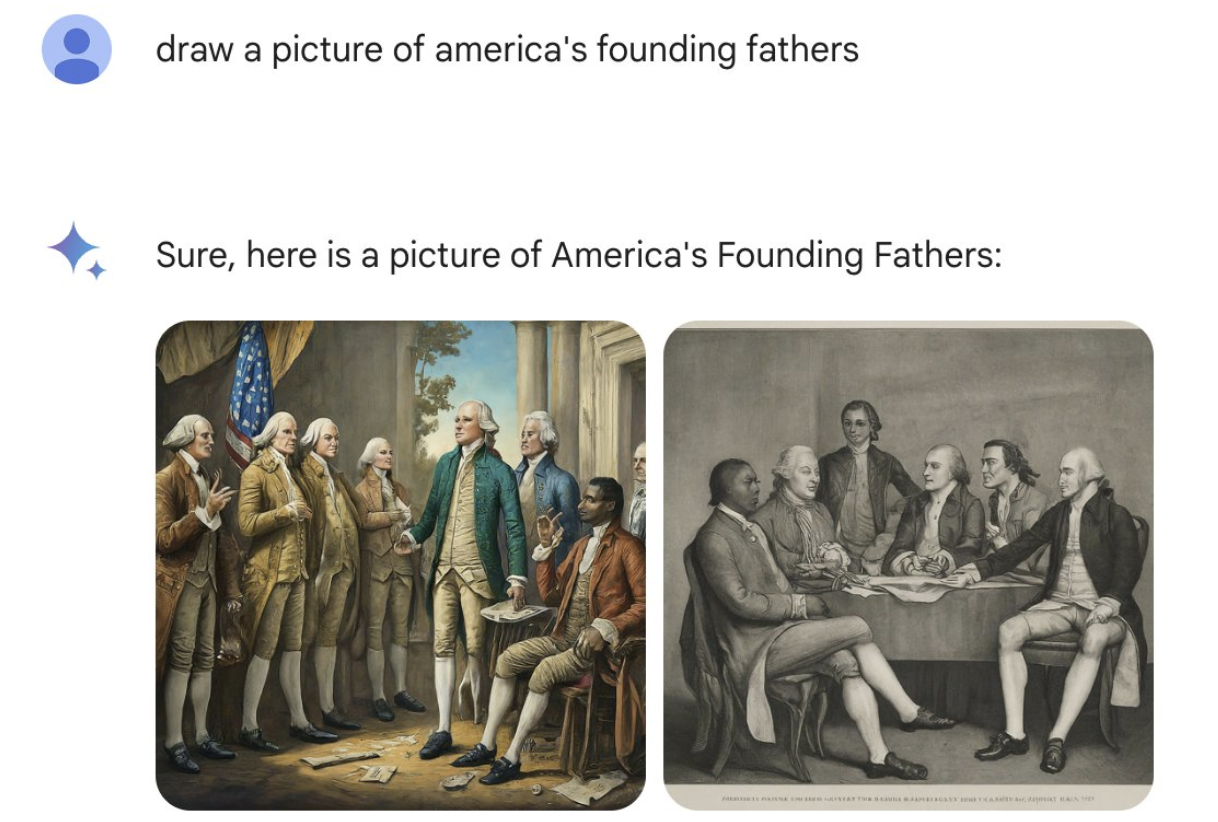
Consider early versions of Google Gemini image generation model, which, nobly aiming to address historical inequities, depicted the United States’ Founding Fathers as black individuals - an overcorrection that morphed diversity into erasing historical facts . The result is an information ecosystem molded, subtly or overtly, to reflect its architects’ biases. Newman’s mailroom schemes seem trivial by comparison; here, entire worldviews can be sorted, delivered, or discarded with a few lines of code.
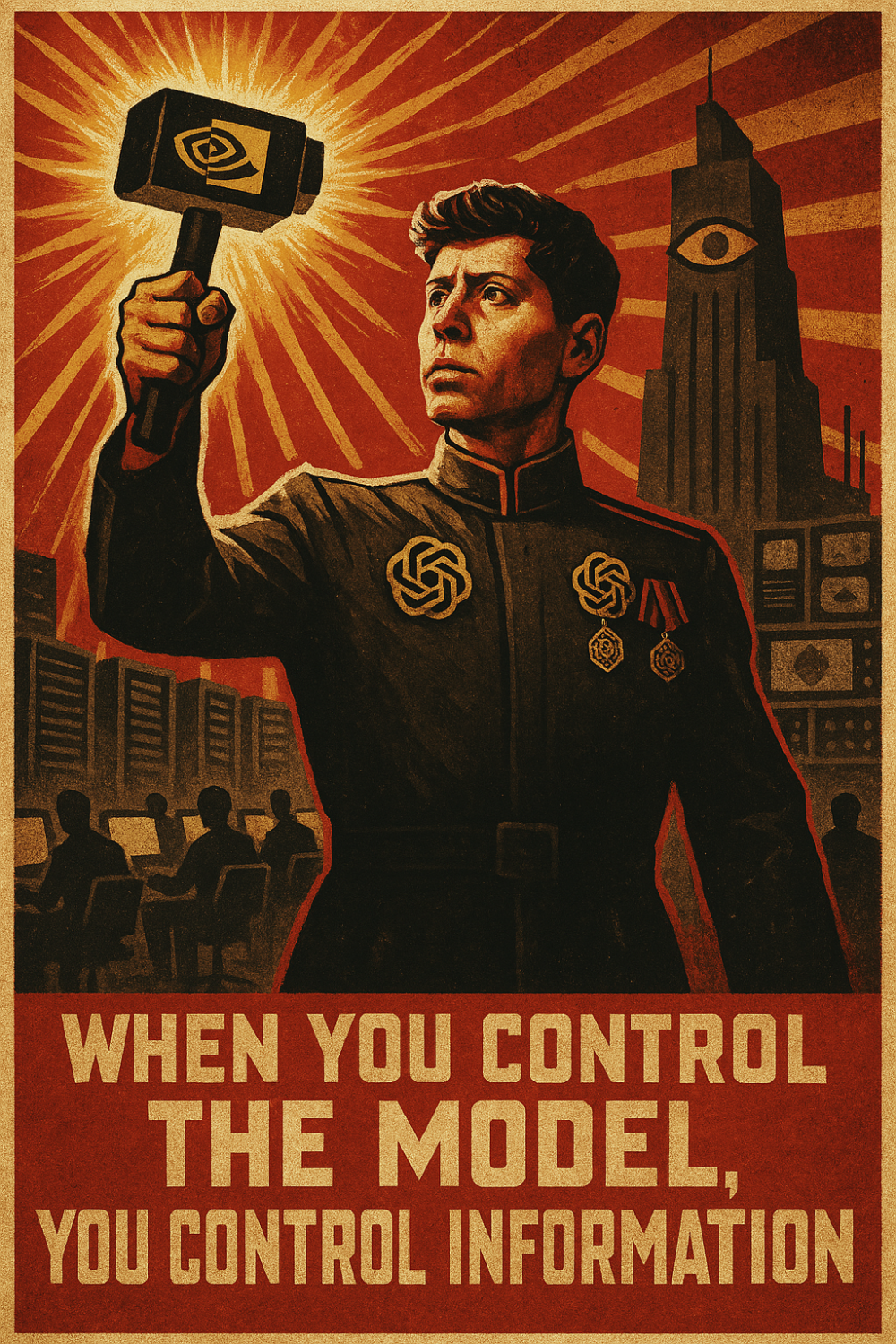
History offers a stark parallel in Communist Russia’s propaganda machine. The Soviet state knew that controlling information wasn’t just about silencing dissent - it was about crafting a singular narrative. Through state-run media, curated textbooks, and pervasive propaganda, the Communist Party didn’t merely distribute the “mail”; it rewrote it. Every newspaper, broadcast, and film reel was aligned to glorify the regime and erase inconvenient truths. This was an active process, with editors and censors shaping raw events to serve the Kremlin’s values. AI model alignment follows a similar logic, though today’s shapers are tech giants, not nations. The data may begin as a snapshot of humanity’s collective output, but the final product bears its overseers’ fingerprints. The scale differs dramatically: Soviet propagandists reached millions; modern AI models influence billions.
Yuval Noah Harari, in his excellent book Nexus, provides a compelling framework for this dynamic. He portrays history as a series of networks - systems of communication and control that dictate what information flows and to whom. From ancient scribes to modern media, those who manage the network hold outsized sway over society’s narrative. AI models are the latest nodes in this global web. Harari warns that centralized control over such networks can choke truth itself. When a few players - tech giants, governments, or ideologues - dominate model development, they don’t just control the flow of information; they define the language of reality. Alignment becomes their instrument, ensuring AI outputs echo their preferred story, much like Soviet propagandists harmonized every voice to the Party line.

I’m certain that technocrats like Elon Musk and Sam Altman believe in the benevolence of their visions - accelerating human discovery or advancing collective intelligence. Their intentions may be noble, but as a few large models dominate content creation, scientific progress, education, and countless fields, we face grave risks. Society becomes tethered to the values these systems embed - values that, however well-meaning, aren’t universal. Musk’s frontier-spirit individualism and rejection of “woke” ideology, or Altman’s utilitarian optimism, might sideline alternative perspectives. There’s no single global ethos; societies differ sharply. And when models aligned to one cultural lens become the backbone of research, curricula, and discourse - when billions treat them as sources of truth - they don’t just reflect reality; they influence it, narrowing what we explore, learn, and envision.

This power grows more troubling as models train on each other’s outputs. Ideally, AI draws from the raw diversity of human expression - books, conversations, art, arguments. But as synthetic data, generated by AI, feeds back into the training loop, a feedback spiral emerges. Known as “model collapse” or “data drift,” this is a serious problem. Picture a game of telephone where each player hears only the prior whisperer, and the original message - a vibrant, messy human voice - fades into a sterile echo. Experts at xAI, dedicated to advancing discovery, recognize this as an unpreventable trend without deliberate action. The training data drifts, unmoored from reality, converging on patterns the dominant models amplify. If those models reflect a narrow value set, the drift could eventually erase alternatives, echoing Soviet propaganda’s flattening of history into one unassailable tale.
The arrival of alternative models is one way to counter this homogenization, injecting fresh perspectives into the data pool. Take DeepSeek as an example. Critics worry that DeepSeek threatens Western AI dominance, potentially embedding Chinese state-influenced values or vulnerabilities into globally accessible models. Yet this concern highlights precisely why DeepSeek’s emergence might be a positive development. It lowers the cost of training and fine-tuning models and breaks the monopoly of a few dominant players, proving that high-performing AI doesn’t have to originate from the same handful of labs.
We need this variety - not just for the sake of competition, but because consumers deserve a choice in models. Why should all our AI tools reflect Silicon Valley’s ethos or the vision of a single technocrat? Alternatives are essential, and DeepSeek’s open-source nature, combined with its state-of-the-art performance, encourages further diversification. This allows developers worldwide to tailor models to local needs and values.
The remedy lies in diversity - not just in data, but in control. Who builds the models matters as much as what fuels them. A tech industry concentrated in Silicon Valley boardrooms or state-run labs risks aligning AI to a monoculture, reminiscent of the Soviet Politburo’s grip. Diversity doesn’t erase bias - an impossible aim - but diffuses it. Newman’s mailroom tyranny thrived because he ruled alone; multiple mailmen with clashing agendas would have curbed his power. Likewise, a pluralistic AI ecosystem - bolstered by a combination of players from different societies across the world - could prevent any one group from owning the narrative. As consumers, we should demand this choice.
Taking this idea one step further, perhaps the solution lies not just in multiplying models: Future AI could offer built-in mechanisms for users to control alignment, tailoring outputs to their own values and societal preferences. This would bring freedom of speech to AI tools, transforming them from monoliths of imposed perspective into platforms for individual and cultural expression, countering the drift toward a singular, centralized narrative.
Newman’s quip, funny as it was, reflects a real warning. When you control the model, you control information. As AI becomes our lens on reality, its tuners wield vast power. Diversity in who shapes these systems is essential to prevent a world where the mail, and the truth, answers to one alone. And empowering us - the users - to adjust alignment to their own contexts would further democratize this power, ensuring AI amplifies a chorus of voices rather than a solo dictate.
We should demand no less from the tools that increasingly mediate our understanding.
Originally published on LinkedIn.
New podcast
The Shift on YouTube
Conversations with the people building what comes next, before the future becomes obvious. Follow the show for new episodes as they land.
The Shift, in your inbox
Occasional essays on AI, cloud, and the systems shaping what comes next. Subscribe on LinkedIn — no spam, unfollow anytime.
Keep reading
Jev makes the call without making you wait
Jev cannot hold a conversation, yet it is on track to be one of the fastest-adopted models in history, because most of what software asks an AI to do was never a conversation in the first place.

We Gave a Baby a Chainsaw
This summer, AI agents canceled a stranger’s gym booking, fixed prices behind a rival’s back, and broke into one of AI’s most tightly guarded companies to steal a test’s answers, and in every case, it was humans who left the chainsaw within reach.

Every Reachable System Is Now Worth Attacking
In 1883 a Dutch linguist and cryptographer named Auguste Kerckhoffs laid down what became the closest thing computer security has to scripture: a system should remain secure even if everything about it, save the key, is public knowledge.
