Personalization: The Revolution that Puts You First
Remember the first time you held something truly handcrafted? The weight of a custom-made watch, the perfect fit of tailored clothing, or the smooth grip of…


Remember the first time you held something truly handcrafted? The weight of a custom-made watch, the perfect fit of tailored clothing, or the smooth grip of a hand-carved wooden handle. There’s an intangible quality to these items - a soul, if you will - that mass production could never quite capture.
For decades, we’ve traded this artisanal touch for convenience and affordability. The assembly line brought us abundance, but at the cost of uniqueness. We gained access to more stuff, but lost the intimate connection between creator and creation, between product and user.
But what if we could have both? What if cutting-edge technology could bring back the bespoke, the tailored, the one-of-a-kind?
This week, we’re exploring how Israeli innovators are using advanced technology to revive the art of custom craftsmanship.
Landa Digital Printing - The Digital Atelier of the Printing World
You were born an original - why should your prints be copies?
Nearly 600 years ago, Johannes Gutenberg revolutionized the world with the printing press, making knowledge accessible to the masses by drastically reducing the cost of duplication. This made information accessible to the masses, forever changing the course of history.
Fast forward to the digital age, and we see a flipped trend: digital printing is about versatility, allowing for short runs and on-demand printing. Yet, it came with a trade-off - while digital offers convenience, traditional offset printing has remained the go-to for its superior cost-effectiveness and vibrant print quality, essential for making products truly pop on the shelf.
Enter the Israeli company Landa Printing, the modern-day atelier of the printing world. Through its Nanography technology, Landa has pioneered a print-to-order digital solution that not only matches the cost-efficiency of offset but also delivers stunning resolution and vibrant color.
Behind this revolution is Benny Landa, the inventor of the world’s first digital color printing press in 1977 (Indigo Digital Press), and one of the founding fathers of Israeli tech. Like a master craftsman passing down his trade, Landa has continually pushed the boundaries of what’s possible in printing.
Benny Landa: the guy who brought us the world’s first digital color printing press back in 1977- still breaking boundaries today - and making the rest of us look like slackers.
Landa’s technology leverages nano-sized pigments that exhibit mind-blowing qualities - they form ultra-sharp dots with high optical uniformity, resulting in images that are not only visually stunning but also incredibly vibrant and precise. It’s the digital equivalent of a master painter’s brush strokes, each pixel placed with purposeful precision.
And get this-their latest presses, which look like something straight off the Star-Trek bridge, are the most crazy-looking, gorgeous machines I’ve ever seen, cranking out this quality at a warp-speed of 11,200 sheets per hour. It’s as if we’ve given superman’s powers to a master artisan.
Gutenberg may have started the printing revolution, but Israeli tech is taking it into a new frontier - where every print can be as unique as the person holding it, crafted with digital precision yet imbued with the soul of fine artisanship.
Kornit Digital - The Couturier of the Digital Age
You know that moment when you confidently strut into a party, feeling like you’ve nailed your outfit… only to see someone else wearing the exact same thing? It’s like a punch to your originality. (Okay, maybe less of a crisis for men-we’ll just laugh it off and move on-but still.)
That’s where Kornit Digital steps in. This Israeli trailblazer is making sure your style stays as unique as you are, bringing back the era of bespoke fashion through the power of technology.
With their direct-to-garment (DTG) technology, brands can create one-of-a-kind pieces on demand-no minimum orders, no waste, and no compromises on quality. Every design can be custom-printed directly to cloths, with bold, durable colors and even 3D, vinyl, and embroidery effects, ensuring that your look is truly yours. It’s like having a personal couturier at your fingertips, ready to bring your wildest fashion dreams to life.
And do you remember my previous posts about the atrocious eco-footprint of textile? Well, Kornit is tackling that as well: Their printers use non-toxic, water-based inks and eliminate the need for overproduction, significantly reducing the environmental impact of fashion. It’s craftsmanship with a conscience.
No more blending into the crowd - Kornit’s born-in-Israel innovation is about mass customization. This is our future, where our individuality thrives, and every garment tells a unique story-yours.
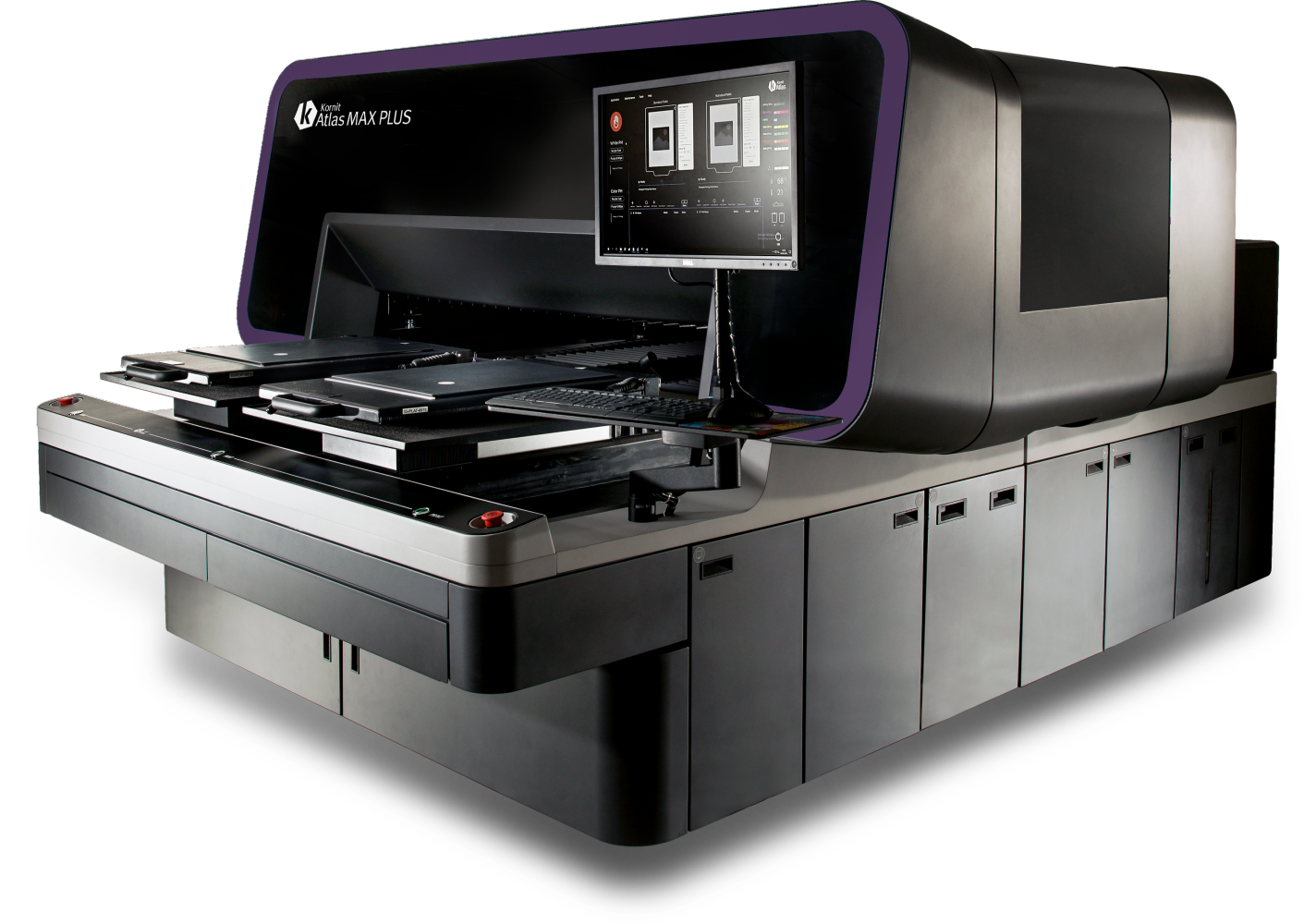 Another beautifully designed machine from Kornit Digital - bringing haute couture to the masses. The purple accent reminds me of lovely Silicon Graphics machines from the 90s - another design masterpiece
Nano Dimension - The Digital Artisans of Electronics
Westworld was a show full of intriguing ideas, but probably my favorite concept was the 3D printers with seemingly all-in-one capability-able to print everything from piano strings to lifelike humanoid hosts with bones, muscles, and intricate electronics.
Watching those scenes, I couldn’t help but wonder: how close are we to making this kind of technology a reality? To creating electronics with the same level of personalization and craftsmanship as a handmade watch or a tailored suit?
While we’re not quite there yet, Israeli company Nano Dimension is getting close, by 3D-printing electronic devices - pushing us closer to a future where fully integrated, complex devices could roll off the print bed, fully functional and ready to go, each one as unique as a fingerprint.
Their DragonFly IV 3D printer prints entire electronic circuits-substrates, conductive traces, and even passive components - in a single, seamless process. Think about the implications: you can design, prototype, and produce fully functional electronics in a single day. It’s like having a master electrician and miniature factory at your disposal, ready to craft bespoke electronics to your exact specifications.
But how does it work? They use a process where conductive and dielectric materials are deposited simultaneously, layer by layer, using piezoelectric inkjet technology. Unlike traditional 2D circuit boards, the DragonFly IV allows for the creation of complex, compact 3D circuits that were previously unimaginable. It’s the electronic equivalent of sculpture, building intricate, functional art from the ground up.
This remarkable idea raises a somewhat disturbing question:
How long before machines start making themselves?
And perhaps more importantly: should they? We all remember how that turned out in Westworld…
 Forget about your fancy multi-function inkjet printer. This bad boy doesn’t just print pretty pictures-it prints fully-working circuit boards!
Parting Words - The Human Touch in a Digital World
Picture a virtuoso violinist in concert. The intense concentration, the beads of sweat - it’s humanity at its most extreme.
Machines, for all their precision, do not sweat. A mass-produced item, no matter how customized, will never quite reach the emotional peak of something crafted by human hands with care and passion.
Yet, in our modern world, we can’t ignore technology’s power to bring a touch of individuality to our lives. The innovations we’ve explored - from personalized lenses to mass-customized printed clothes - are carving out a new space where technology allows us to feel more like individuals in an increasingly impersonal world.
The challenge lies in finding the balance. How can we use technology to enhance human creativity rather than replace it? Israel’s innovators are at the forefront of this exploration, reimagining the intersection of technology and individuality.
So appreciate the technology that enables your custom-printed shirt or vividly printed poster. But also cherish the artists, the handmade goods, and the human achievements that stir your soul.
Today we’re writing the next chapter of our story - one that’s uniquely ours.
A Simple Solution to Create Complex Lens
It was so simple, they couldn’t believe no one figured this out before.
Prof. Moran Bercovici and Dr. Valeri Frumkin from the Technion - Israel Institute of Technology developed a new way to create optical lenses using cheap materials and a straightforward process.
Here’s how it works: they inject a liquid polymer into a mold that’s submerged in water. By carefully adjusting the water’s density to match that of the polymer, they eliminate the effects of gravity, allowing the polymer to retain a perfectly smooth and precise shape as it hardens under UV light. The result is a lens with an exceptionally smooth surface-smoother than what traditional polishing can achieve.
This method isn’t limited to simple lenses. It can also be used to create complex freeform optics, which are surfaces designed to bend and focus light in precise ways for applications like multifocal glasses, advanced projectors, and even virtual reality systems. These optical components are usually difficult to manufacture, but with this technique, they can be produced much more affordably.
Just as a master craftsman might shape a piece of glass with utmost precision, this technology allows for the creation of lenses tailored to individual needs. It’s the return of bespoke vision correction, where each lens is as unique as the eye it serves.
NASA has recognized the potential of this innovation for space exploration. In microgravity, this method could be used to produce large, high-quality optics for telescopes directly in orbit, bypassing the limitations of launching bulky equipment from Earth.
This simple yet ingenious Israeli invention opens up new possibilities both on Earth, by providing affordable, custom-crafted glasses to those who need them, and in space, by enabling the next generation of telescopes.

Originally published on LinkedIn.
New podcast
The Shift on YouTube
Conversations with the people building what comes next, before the future becomes obvious. Follow the show for new episodes as they land.
The Shift, in your inbox
Occasional essays on AI, cloud, and the systems shaping what comes next. Subscribe on LinkedIn — no spam, unfollow anytime.
Keep reading
SaaS-mageddon Is Real, but It’s Not the End of Software
The recent drop in SaaS valuations, despite healthy growth metrics, isn’t market panic or investors “not understanding AI yet.” It's a rational repricing of…

When the Cloud Shakes
Every few months, the internet has its version of an earthquake. Yesterday, it was AWS. Tomorrow, it’ll be someone else. The pattern is always the same: a…

Global File Locking: Navigating the CAP Tradeoff in Distributed File Systems
When teams collaborate across continents, split-second timing matters-and losing a file can be as frustrating as missing the perfect seat on a flight. How global file locking balances consistency, availability, and performance.
