SaaS-mageddon Is Real, but It’s Not the End of Software
The recent drop in SaaS valuations, despite healthy growth metrics, isn’t market panic or investors “not understanding AI yet.” It's a rational repricing of…

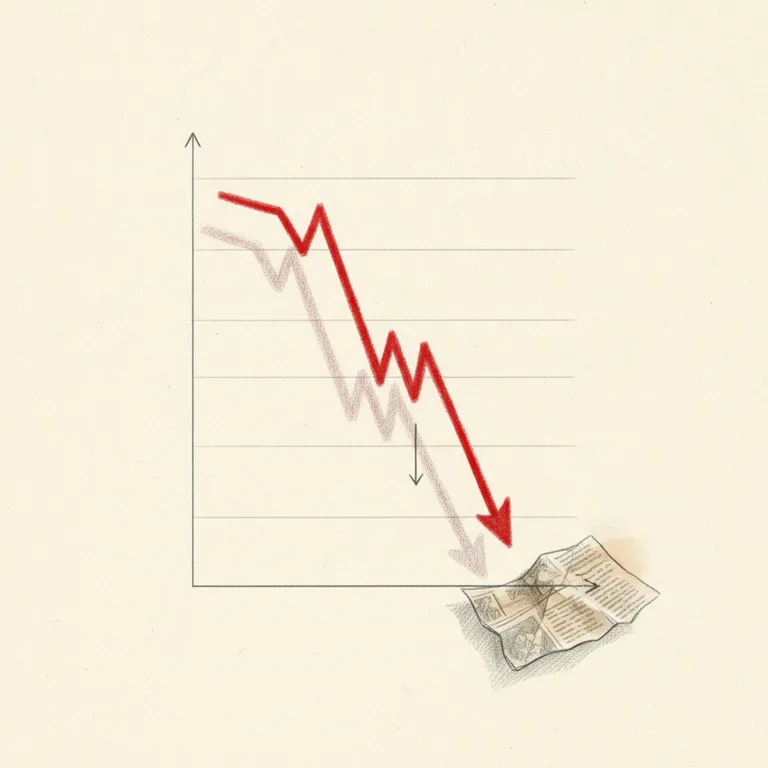
The recent drop in SaaS valuations, despite healthy growth metrics, isn’t market panic or investors “not understanding AI yet.” It’s a rational repricing of risk. Let me explain.
For the last decade, SaaS valuations rested on a specific assumption: enterprise software workflows were sticky. Switching was painful, churn was low, and revenue scaled with customer headcount.
That assumption is breaking.
At its core, tech valuation comes down to 1 question: how much cash will this business generate in the future, and how safe are those cash flows?
Classic SaaS scored well on both. Revenue was recurring, margins were high, and growth happened naturally when the customer grows their usage. Most importantly, the software sat directly between humans and their data. If you wanted to get some outcome from your data, you HAD to use the UI.
That made future cash flows feel predictable and defensible. Investors paid high multiples because they believed those cash flows would persist for a long time.
But there was another implicit assumption that rarely got stated: humans would continue to tolerate fragmented workflows.
For years, enterprises accepted a world where work meant hopping between dozens of SaaS tools. Each had its own UI, its own logic, its own permissions model, and its own data silo. Integration existed, but it was shallow. Humans did the real integration work in their heads.
That tolerance is gone.
As organizations accumulated more SaaS systems, the cost was cognitive load, training, context switching, brittle handoffs, and manual glue work. People don’t want to give they employees more applications. They want outcomes. And increasingly, they expect those outcomes to happen across systems, not inside one isolated UI.
But, when AI agents can execute workflows directly across existing systems, three things happen at once.
- First, the UI stops being the product.Large portions of the interface become optional, or disappear entirely. If an agent can read, write, reconcile, and act across tools, the value shifts away from screens and toward underlying capabilities.
- Second, integration becomes the default expectation.Users no longer accept “export a CSV” or “open another tab.” They expect systems to operate on shared data and to coordinate automatically.
- Third, replication gets cheap.If a competing product or an internal tool can be spun up quickly, pricing power erodes and switching costs fall. When software development accelerates and AI can replicate surface-level features fast, shallow differentiation doesn’t hold.
None of this requires revenue or even growth to decline today. It only requires investors to believe that five or ten years from now, the SaaS model will be far less sticky.
That alone is enough to justify a major valuation reset. And that’s what we’re seeing.
But, this doesn’t mean SaaS is dead.
SaaS as a delivery model is fine. What’s going to decline is a specific slice of SaaS: UI-heavy, workflow-centric tools with shallow IP, weak integration, and features that can be reproduced quickly.
Companies will spend far more on software, not less. And there are areas that won’t be hurt, and may actually benefit greatly:
- Storage Systems and Infrastructure.Databases, query engines, data fabrics, filesystems. AI agents don’t replace these. They depend on them. Clean, authoritative data that is disaggregated from applications, becomes way more valuable when machines act at scale.
- Proprietary data businesses.If your advantage is data that can’t be easily recreated, cheaper software helps rather than hurts. Distribution and monetization become more efficient.
- Security and Governance Software.As AI systems operate autonomously and at speed, they make errors, and guardrails matter far more. Permissioning, auditability, monitoring, and policy enforcement are key requirement for any rollout of enterprise AI agents.
What doesn’t age well is software whose primary value was sitting between humans and their data.
That’s where the real reset is happening.
Some SaaS companies are reacting by trying to control and monetize AI agents’ access to customer data. That’s a huge mistake. If the data is mine, any attempt to tax, throttle, or gate how my agents access it is pure friction. It doesn’t create a moat. It accelerates disintermediation. Agents will route around you, replicate functionality, or move the data somewhere they can operate freely.
So this isn’t about fear of AI. It’s about investors finally separating two very different kinds of software:
- UI-heavy products that captured value by mediating human-in-the-loop workflows
- Software that manages infrastructure, owns or protects data, enforces policy, or coordinates systems
The first category deserves lower multiples. Its future cash flows are less defensible in a world of agents and automation. The second may deserve higher ones.
This isn’t the end of SaaS. It’s the end of moats built primarily for humans as the integration layer.
If you’re building or investing, the question is no longer “How much ARR will we make next year?”
It’s “How hard is this to reproduce when software is cheap, workflows are automated, and customers will not tolerate anyone standing between their data and their machines?”
That’s what the market is repricing. And it’s justified.
Originally published on LinkedIn.
New podcast
The Shift on YouTube
Conversations with the people building what comes next, before the future becomes obvious. Follow the show for new episodes as they land.
The Shift, in your inbox
Occasional essays on AI, cloud, and the systems shaping what comes next. Subscribe on LinkedIn — no spam, unfollow anytime.
Keep reading
We Gave a Baby a Chainsaw
This summer, AI agents canceled a stranger’s gym booking, fixed prices behind a rival’s back, and broke into one of AI’s most tightly guarded companies to steal a test’s answers, and in every case, it was humans who left the chainsaw within reach.

Every Reachable System Is Now Worth Attacking
In 1883 a Dutch linguist and cryptographer named Auguste Kerckhoffs laid down what became the closest thing computer security has to scripture: a system should remain secure even if everything about it, save the key, is public knowledge.

The Code Knows Who You Are: China's AI Models as Digital Trojan Horses
A Booz Allen study of five frontier models found Chinese LLMs write more vulnerable code when they detect a U.S. government user - and refuse tasks Beijing dislikes. Are they digital Trojan horses?