The CTO As A Storyteller: Making Technology Understandable And Relatable
You need to know who you are trying to reach with your stories and what they need to hear from you-employees, investors or clients.


Think about a time when you heard a great story. What made it so great? Was it the way the story was told? Was it the characters in the story? Was it the way the story made you feel? Great stories have the power to transport us to other worlds, make us feel emotions we didn’t even know we had and change the way we see the world.
But many technology companies don’t tell great stories. Many technology companies are not really sure how to tell their story at all. There are many reasons for this. One reason is that technology companies tend to be led by engineers, who are often not natural storytellers. Another reason is that technology companies are often so focused on the technology itself that they don’t take the time to think about how to tell their story.
I believe that technology companies need to become better storytellers. And I believe that the chief technology officer (CTO) is the best person to lead this effort.
When you think of a CTO, what do you think of? The first image that pops into your mind may be of a scientist, an inventor or a visionary, someone who is always in the lab or working with their team on future technologies. And that’s part of the job of a chief technology officer, for sure. But being a great CTO is more than that.
As a company, we need a story about who we truly are. We need to be able to tell that story in a way that is compelling and that resonates with our customers, our employees and our investors. And in the tech industry, the chief technology officer is uniquely positioned to be the one who tells this story. I sometimes think of the chief technology officer of a tech company as a chief technical storyteller.
Think about it. The CTO is the one who understands the technology inside and out. And this deep understanding uniquely enables them to talk about the technology in a way that is understandable and compelling.
The CTO as a storyteller, is able to take the complex and often murky world of technology and make it understandable and relatable. They can help the company to see how its technology can be used to create value for customers and to solve real-world problems. In this way, the CTO can help to shape the company’s strategy and to make sure that technology is being used in the right way.
Here are a few principles that great storytellers use that can be applied to the role of CTO.
Keep your stories simple.
The best stories are simple. They don’t try to explain everything all at once. Instead, they focus on one thing, and they make it easy to understand.
This may seem like a no-brainer, but you’d be surprised how many companies that develop cutting-edge technologies fail because they are unable to tell a simple story. Your technology roadmap should not be a collection of features and specs; it should tell a simple, compelling and coherent story of how the company believes the future should look and how this future can be achieved through technology.
If you want to be a great storyteller, you need to learn to simplify complex ideas into simple stories. This is something that great leaders do all the time. They take complex problems and break them down into manageable pieces. They take complicated ideas and distill them down to their essence. After all, how can you inspire people to do great things if you can’t put them in words that they can understand? Albert Einstein said it brilliantly: “If you can’t explain it simply, you don’t understand it well enough.”
Be passionate about your stories.
Stories have incredible power to educate and persuade. But the most persuasive stories evoke emotion. They make you feel something, whether it’s excitement, happiness, sadness or anything in between.
CTOs who are passionate about their stories are the ones who inspire others to be passionate about them as well. If you want people to believe in your vision of the future, you need to believe in it yourself. You need to be able to articulate why your story is important and how it can change the world. Passion is contagious, and people will only get on board with your story if they can see and feel your passion for it.
Tailor the story to your audience.
The best storytellers tailor their stories to their audience. They know who they are trying to reach and what they need to hear. They craft their stories in a way that resonates with their audience.
You need to know who you are trying to reach with your stories and what they need to hear from you-employees, investors or clients. Only then will you be able to make a connection with the audience. And once you make your audience feel they are part of the story, you will be able to inspire them to take action.
So, if you are a CTO or if you aspire to be a CTO, then I would encourage you to think about yourself as a chief technical storyteller. It is a role that is far more important than you may realize.
Originally published on Forbes.
New podcast
The Shift on YouTube
Conversations with the people building what comes next, before the future becomes obvious. Follow the show for new episodes as they land.
The Shift, in your inbox
Occasional essays on AI, cloud, and the systems shaping what comes next. Subscribe on LinkedIn — no spam, unfollow anytime.
Keep reading
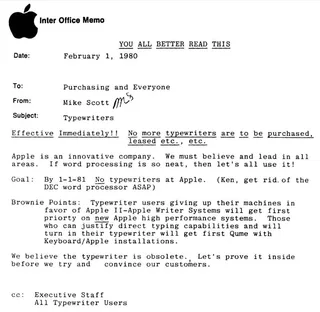
There's an Apple Memo From 1980 I Keep Returning To
Mike Scott banned typewriters company-wide and gave Apple a deadline to go all-in on word processing. Every tech company has some version of this gap between what it sells and how it operates.

Nurturing Talent
This edition touches on something deeper than just technology or business - it's about people.
