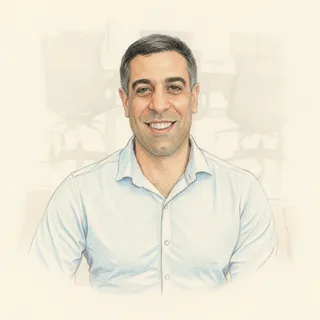
From the Super Bowl to the Pentagon
A Conversation with Aviv Shapira, Co-Founder and CEO of XTEND


In 2016, millions of viewers tuned in to watch the Super Bowl, mesmerized not just by the game but by insane instant Matrix-style replays that let them experience the action from the quarterback’s perspective. Behind this innovation was Aviv Shapira and his team at Replay Technologies, whose Emmy-winning work transformed sports broadcasting. Their immersive 3D video technology brought fans closer to the game than ever before, redefining how we experience sports.
Fast forward to today, Aviv is once again at the cutting edge of technology, but this time, his work isn’t about entertaining fans - it’s about saving lives! As co-founder and CEO of XTEND, Aviv has transitioned from creating immersive replays to a much more serious game - building advanced drones used by military forces around the world.
XTEND’s AI-powered autonomous systems and tactical drones are now relied upon by the IDF, the Pentagon, and other global defense organizations to navigate complex combat scenarios, all while keeping human operators out of harm’s way.
In this conversation, Aviv shares his journey from replays to robotics, explains how XTEND’s AI-powered drones are reshaping defense operations, and reflects on the ethical and technical challenges of this rapidly evolving field.
Aron:Aviv, I find it incredible how your journey took you from building technology for broadcasting sports to developing tactical drones for the military. How did one thing lead to another?
Aviv: Yes, the transition from immersive sports broadcasting to defense technology might seem unexpected, but at its core, both involve leveraging cutting-edge technology to enhance human capabilities:
At Replay Technologies, we redefined how fans experienced sports through real-time 3D video. That same focus on intuitive human-machine interaction led to XTEND, where we develop drones and operating system that enable operators to interact with complex environments seamlessly & remotely.
What bridged the gap was the desire to apply these innovations to life-saving applications. By merging immersive technology with AI & autonomous capabilities, we provide defense and security forces with greater control and safety in high-risk scenarios.
Aron:I’ve heard of other companies leveraging drones for security and combat use cases. What sets your technology apart, and how do you maintain this competitive edge?
Aviv: We stand out by prioritizing intuitive, human-centered technology. Unlike traditional military systems that demand extensive training, our AI-powered drones or other smart machines can be operated with minimal effort, functioning as natural extensions of their users. This is powered by XOS (XTEND Operating Systems) which integrates AI autonomy while keeping human oversight at the core.
Our competitive edge comes from continuous innovation and close collaboration with defense organizations. Our partnership with IDF DDR&D allows us to fast-track field-driven solutions. For instance, during the recent Iron Swords war, we developed and deployed an urban warfare platform in just three months - now successfully operational.
Aron:I get it. In essence military equipment is so notorious for being complex and unfriendly to operators, yet, your XOS operating system prioritizes intuitive UX. Can you expand on that?
Aviv:We believe that technology should empower, not complicate. Traditional military systems require extensive training, which isn’t always feasible in fast-changing scenarios. XOS was designed to be as intuitive as a video game, ensuring ease of use without sacrificing operational effectiveness.
The XOS supports third-party applications and various payloads, allowing operators to perform complex missions remotely. This enhances flexibility while significantly reducing risk by enabling control of multiple drones / smart machines from a safe distance.
Aron:Ease of use can certainly accelerate the adoption of drones in high-stakes scenarios. Can you share a recent example of their life-saving potential?
Aviv: During a recent IDF operation, forces needed to enter a fortified building where hostiles were suspected. Instead of risking soldiers’ lives in a direct breach, they deployed XTEND drones to enter, navigate tight spaces, and relay real-time intelligence.
Not only did the drones provide crucial situational awareness, but they also enabled remote threat neutralization. This mission, which could have led to casualties, was completed safely and efficiently, highlighting the game-changing impact of AI-powered human-machine collaboration.
Aron:That’s an incredible success, and any edge against terrorism is invaluable! But thinking forward, does your vision extend beyond the field of defense?
Aviv: Absolutely. Our technology has significant applications beyond defense: Law enforcement, search and rescue, industrial inspections, and logistics can all benefit from AI-powered, user-friendly drones and smart machines.
For example, our platforms participate in the Search & Rescue efforts in the Turkey Earthquake- scanning wracked buildings that were too dangerous for humans to enter, successfully identified survivors, and saving lives.
Aron:Saving lives in natural disasters is an incredible application, and it highlights the need for quick deployment and fast training of operators. That brings me to the future: drone technology is evolving rapidly. Where does XTEND fit into the future of robotics, and how do you stay ahead?
Aviv:The future of robotics and drone operations lies in seamless human-machine collaboration, and XTEND is leading this shift. As AI and automation progress, our focus remains on keeping technology intuitive, adaptive, and human-centric. Our goal isn’t to replace operators but to enhance their efficiency and safety.
We stay ahead by continuously advancing AI, edge computing, and real-time autonomy while ensuring usability. By integrating third-party applications and payloads within XOS, we maintain flexibility and adaptability, staying aligned with evolving operational needs.
Aron:As an entrepreneur who has built multiple successful ventures across very different industries, what advice would you give to aspiring founders?
Aviv: Innovation stems from passion and problem-solving. Whether in sports broadcasting or defense technology, my journey has always been about identifying challenges and leveraging technology to overcome them. If you’re passionate about making an impact, success follows naturally.
Technology evolves quickly, and the ability to pivot, learn, and apply new insights is critical. Surround yourself with a strong team, stay mission-focused, and always question how things can be done better - that’s how breakthroughs happen.
And, you can follow my life moto: “Dream it - Get it”
Aron: Aviv, I think your journey highlights something fundamental. The most powerful technology is the kind that people can actually use. Your work proves that innovation isn’t just about what a system can do, but how easily people can interact with it.
I’d like to thank Aviv for sharing his insights and for reminding us that the best technology is the kind that empowers people, not overwhelms them.
Originally published on LinkedIn.
New podcast
The Shift on YouTube
Conversations with the people building what comes next, before the future becomes obvious. Follow the show for new episodes as they land.
The Shift, in your inbox
Occasional essays on AI, cloud, and the systems shaping what comes next. Subscribe on LinkedIn — no spam, unfollow anytime.
Keep reading
The Code Knows Who You Are: China's AI Models as Digital Trojan Horses
A Booz Allen study of five frontier models found Chinese LLMs write more vulnerable code when they detect a U.S. government user - and refuse tasks Beijing dislikes. Are they digital Trojan horses?

Quantum Computing, Simplified
A Conversation with Dr. Yehuda Naveh, Co-founder and CTO of Classiq

Beyond Nvidia? The Future of AI Acceleration
For years, Nvidia has been the undisputed king of AI chips, soaring to a $3 trillion valuation and becoming synonymous with machine learning, data…